


Our Investment in Index Industries
Index Industries is building the financial infrastructure for a new era of real estate investing.


Fifty years ago, Vanguard opened the first index fund for individual investors. Until then, index investing in the stock market had been the exclusive domain of pension funds and other large institutions. Seventeen years later, SPY, the first U.S.-listed ETF, democratized access further, turning the S&P 500 into a single trade for anyone with a brokerage account. Over the decades that followed, innovations in fund design and trading slowly opened the stock market to everyday investors. By 2022, a record 58% of American households owned stock, directly or through funds, and in 2024, assets in U.S. index funds surpassed those in actively managed funds for the first time.
The $55 trillion U.S. housing market has taken a different path. For generations, the ways into it have been narrow. Most people buy a home, which takes a down payment, a mortgage and months of work, and ties their stake to a single address in a single local market. Some become landlords, taking on tenants, repairs and the concentrated risk of a few properties. Others buy shares of REITs or homebuilders, which trade like stocks and move with each company’s balance sheet and the broader stock market as much as with home prices. Owning homes across many markets has been something only institutions could afford. And while national indices have tracked home prices for decades, they report only monthly, about two months behind the market, and turning those numbers into something people can invest in has proved much harder.
Housing markets are unique in that they face physical-world limitations. Where equity index funds could build on markets where shares were already standardized and readily traded, homes are bought and sold one at a time, through local transactions that take time and substantial capital, leading to high costs and slow exits. While diversified housing portfolios exist, they must be assembled property by property, then financed, maintained and managed, a process that takes years, large balance sheets and full-time operating teams. For decades, that has been the gap: most investors could own a house, but not the housing market.
Enter Index Industries.
Index Industries is building what it takes to invest in U.S. housing as a whole: a reliable daily price for the market, and the infrastructure to build investment products on top of it.
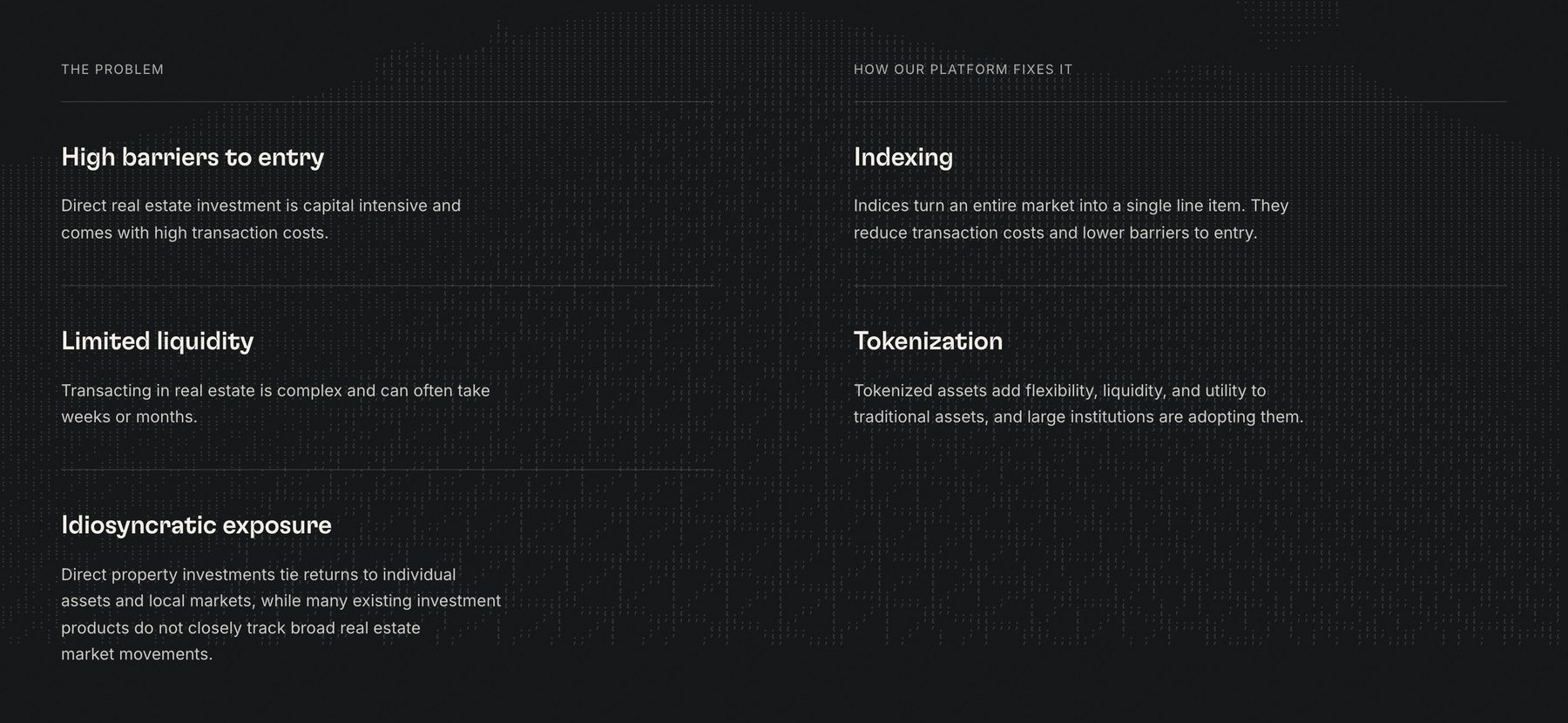
Index Industries’ U.S. Home Price Index takes those monthly indices and turns them into a single, continuous national measure, calculated daily, with a methodology reviewed by an independent housing analytics firm. They then pair the index with the technology and services other companies need to build investment products around it. The first application of that technology is USHP, a first-of-its-kind liquid, investable index referencing the U.S. housing market.

Index Industries is the newest chapter of a story we have watched up close. We’ve been fortunate to work closely with co-founder Brian Hardecker for many years. A former Principal at Blackstone, Brian founded Longmark, a MetaProp portfolio company that focuses on housing-related investment management, and Longmark now serves as a strategic partner to Index Industries. Across multiple investments in Longmark, we have watched him set herculean goals and execute against them, with exceptional founder-market fit for a business that sits where housing meets technical and structural complexity. He has grown Longmark to more than 200 employees, managing $2 billion in U.S. housing-related assets across more than two dozen markets.
Brian is joined by co-founder Josh Rosenthal, who first backed the company as an investor before leaving to lead it as CEO. Josh’s extensive background in traditional finance and digital assets, from Goldman Sachs and J.P. Morgan to FalconX and Polychain, brings the capital markets expertise to match Brian’s depth in housing.
We are thrilled to join Lightspeed Venture Partners, Polychain Capital, Galaxy Ventures, Wintermute Ventures, and more in backing Josh and Brian on their mission to make the world’s largest asset class investable in ways it never has been. This week, they emerged from stealth, and the financial infrastructure for a new era of real estate investing will soon run on Index Industries.
Disclosure: Index Industries and Longmark are MetaProp portfolio companies. Nothing here is investment advice or a recommendation of any security.