


Securing the Data Center Buildout
Protecting these projects requires control over a changing workforce, valuable equipment and temporary infrastructure. Technology is helping connect those responsibilities.
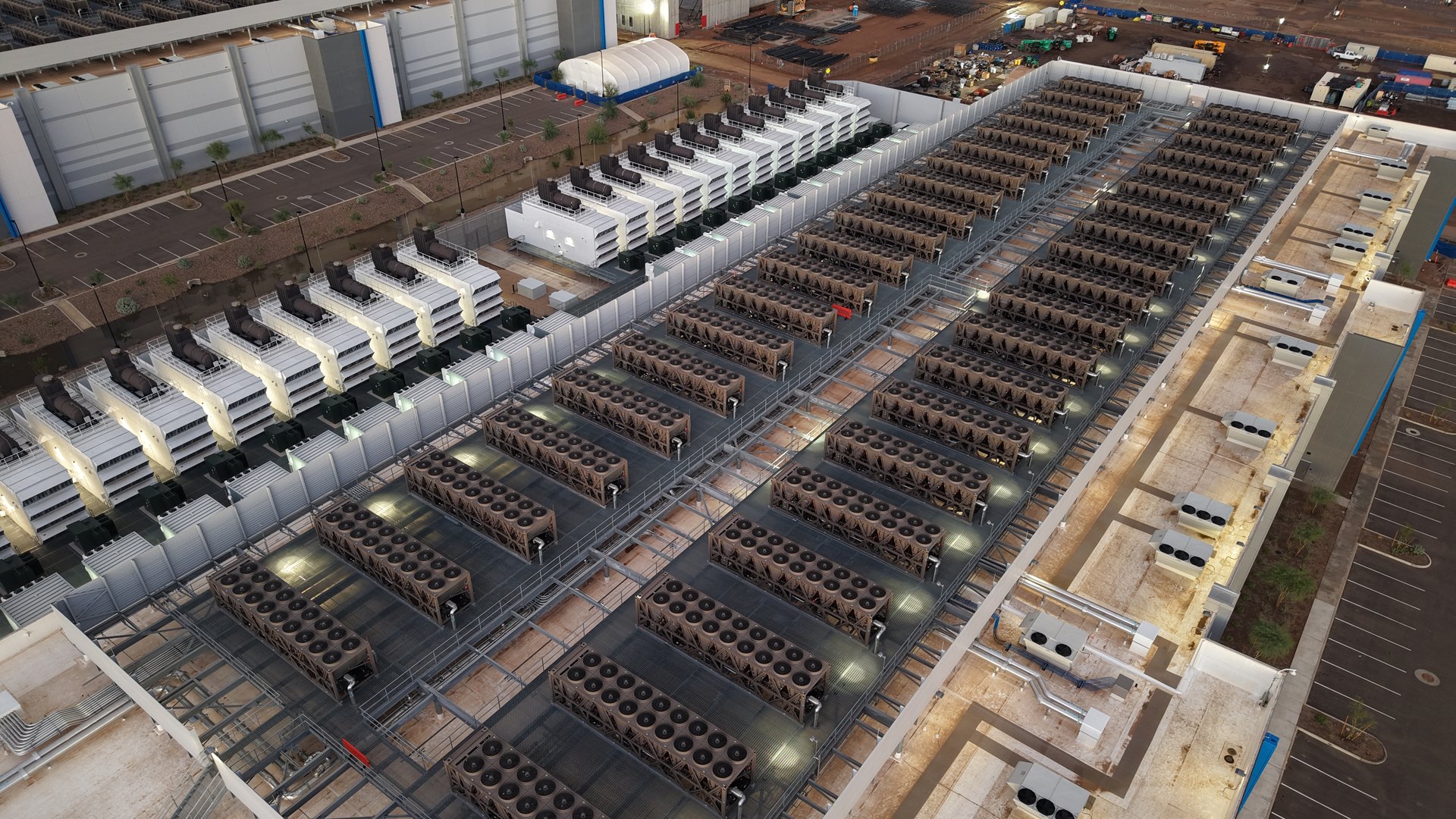

Shortly after midnight in early August, five people drove a rented U-Haul onto a data center construction site off Maries Road in Sterling, Virginia, and loaded it with spools of copper wire worth more than $100,000. Loudoun County deputies were already responding to a burglary report. The truck fled, then crashed. Three men were arrested and the copper was recovered, according to local reporting.
The recovery gave this story a clear ending. For a construction project, however, the value of stolen material is only part of the exposure. If a missing delivery holds up installation or commissioning, the consequences can extend well beyond its replacement cost.
What makes the incident worth a second look is the address: a data center site in Northern Virginia, at the center of an infrastructure buildout whose scale is changing what contractors are being asked to protect.
The build is now bigger than the buildings
U.S. data center construction starts totaled $81.5 billion in the first half of 2026 alone, surpassing the full-year 2025 figure of $72.5 billion, according to ConstructConnect. Its data also shows the average project value reaching roughly $1 billion over the twelve months through June 2026, up from $438 million in the preceding period.
U.S. data center construction
Private construction spending put in place, $ billions
$8.5B2019
$9.2B2020
$9.9B2021
$12.6B2022
$20.0B2023
$34.8B2024
$49.7B2025
$63.8B2026E
Source: U.S. Census Bureau. 2026E annualizes January to July.
These are capital-intensive projects long before they contain operational servers. Electrical and mechanical systems account for much of the build cost. Transformers, switchgear, cooling equipment and wire must move through delivery, storage, installation and testing while the site itself is still changing.
The broader construction industry already faces a substantial security workload. TrueLook and Noonlight recorded 2,639 confirmed break-ins across the commercial construction sites they monitored in 2025, a reported increase of roughly 50 percent from 2024. More than 40 percent occurred on weekends. These are observations from a vendor’s monitored sites, not a national crime rate or a data-center-specific sample.
For an owner, the practical question is what a loss does to the job. A stolen spool of wire may be replaceable from stock. A missing component needed for a scheduled installation may require a new delivery, a resequenced crew or a delayed test. The same dollar loss can have very different consequences depending on where it falls in the construction schedule.
The security inversion
A commissioned hyperscale data center is a tightly controlled environment. Microsoft’s published controls, for example, describe screening, time-limited access, identity checks and restrictions on movement within the facility. Access rights are reviewed and removed when they are no longer needed.
During construction, those controls have to work in a less stable setting. Gates move. Work zones change. Equipment sits in laydown yards. Crews arrive for a particular scope and leave when it is finished. The site needs to admit deliveries and workers without allowing yesterday’s authorization to become indefinite access.
The difficulty is maintaining that discipline through the build. A plan written for the completed facility cannot, by itself, resolve the daily changes at a construction gate.
This is the security inversion: valuable infrastructure can arrive before the permanent systems intended to protect it are fully available. It does not mean security planning starts at turnover. AWS explicitly describes security as part of site selection and design. It means the construction phase needs its own controls, matched to temporary infrastructure, subcontractor turnover and changing custody of materials.
| Project phase | Changing condition | Control requirement |
|---|---|---|
| Early works | Temporary access, power and connectivity | Deploy protection that can operate independently. |
| Equipment delivery and installation | Materials arrive; crews and work zones change | Track access permissions and responsibility for deliveries. |
| Commissioning and handoff | Construction and operations responsibilities meet | Update permissions, assign ownership and retain evidence. |
The perimeter is the easy part
The instinct is to buy more fence, more cameras, more lighting. Those help, and the perimeter category has real products in it. But detecting activity is only the first step in deciding how to respond.
One finding from TrueLook and Noonlight explains why. Their monitoring teams processed more than 170,000 alarms in 2025. Routine employee activity accounted for roughly 29 percent of false alarms. A substantial part of the monitoring task is distinguishing expected activity from an event that needs intervention.
A superintendent checking the site after hours and someone removing material without permission can both trigger a camera alert. The person reviewing it needs context: who is present, which contractor they work for, whether they are authorized to be there at that hour, and what activity was expected. Better image recognition helps, but it does not supply a missing work authorization.
A perimeter system can detect presence. Connected identity and work records help determine whether that presence is legitimate.
A camera can show a person on site at 1 a.m. It cannot, on its own, show that the subcontractor finished work in March and the badge was never deactivated. That answer comes from the assignment and access records.
On a large campus, the contractual chain makes that harder. The general contractor may hire a mechanical subcontractor, which hires an insulation subcontractor, which staffs through an agency. A badge can be valid in one system even after the underlying assignment has ended. Keeping the record current requires someone at each tier to report changes, and a process that carries those changes through to access at the gate.
The labor shortage is a security problem
Labor pressure makes that operating problem more urgent.
Associated Builders and Contractors estimates that the industry needs to attract 349,000 net new workers in 2026 and 456,000 in 2027 to meet construction demand. Data center contractors are recruiting into that market while trying to staff specialized electrical, mechanical and commissioning work.
When a crew needs to start quickly, onboarding has to keep pace. The risk is that checks become disconnected: one team confirms the worker’s assignment, another holds the training record, and a third issues the badge. A late substitution can leave each team working from a different version of the roster.
A labor shortage does not establish that workers are poorly vetted. It does increase the value of a process that can verify people quickly and consistently, including the small subcontractor arriving with two workers and a phone.
The obligations are concrete but distinct: work authorization, licenses or certifications required for a particular scope, subcontractor insurance requirements, applicable wage rules and removal of access when a crew demobilizes. Software can help track the evidence and flag exceptions. The responsible employer or contractor still has to resolve them.
What is above the fence
The fence also leaves the airspace above a project to consider. In testimony submitted to the House Homeland Security Committee in July 2025, DroneUp’s CEO cited more than 13,000 drone incursions detected at U.S. power generation sites in 2024, drawing on figures attributed to Dedrone and E&E News. That is evidence from adjacent critical infrastructure, not a count of attacks on data center jobsites. It nevertheless raises a relevant question for sites holding sensitive equipment: can the security team recognize and investigate an unexpected overflight?
The response requires more than buying a sensor. The FAA’s May 2026 proposal would create a process for restricting drone flights near eligible critical infrastructure. Separately, federal changes have expanded counter-drone authority for certain state, local, tribal and territorial agencies. Neither gives a private construction operator blanket authority to disable an aircraft. The detection method, response plan and coordination with authorized agencies all matter. A useful warning is one that reaches someone who knows what they can do next.
The jobsite security stack
It helps to separate four functions: perimeter protection, identity, airspace awareness and the record of what happened. Each answers a different question. Products can span several, but buying one function does not automatically provide the others.
Layer 01Perimeter
The questionWhat activity needs attention?
Failure to guard againstAn alert without a timely response.
Layer 02Identity
The questionWho is here, for whom, and cleared for what?
Failure to guard againstA working badge with stale authorization.
Layer 03Airspace
The questionWhat is above the site, and who can respond?
Failure to guard againstDetection without a lawful, actionable response plan.
Layer 04Record
The questionWhat happened, and what evidence supports it?
Failure to guard againstLogs and documents that cannot be reconciled.
Perimeter protection remains fundamental. Someone has to notice an open gate or an unexpected vehicle and respond. Its effectiveness depends on camera placement, uptime, monitoring quality and a clear escalation process, as well as the hardware.
Identity and recordkeeping add context to that response and preserve evidence afterward. Their commercial value depends on whether the information is reliable enough for a contractor, owner or insurer to use in a decision. That is a more demanding test than collecting another stream of site data.
Who is building each layer
| Layer | Company | What it offers |
|---|---|---|
| Perimeter and video | LiveView Technologies | Mobile solar-powered monitoring units |
| TrueLook | Jobsite cameras and monitoring | |
| Pro-Vigil | Remote video monitoring | |
| ECAM | Combines the former Stealth Monitoring and ECAMSECURE businesses | |
| Actuate | AI video analytics | |
| Verkada | Cameras combined with other physical-security products | |
| Sensera Systems | Jobsite cameras and visual intelligence for construction teams | |
| Odin | Also offers video monitoring | |
| Workforce, identity and safety | Odin | Worker onboarding, credential verification, badging and access control, extending into video monitoring, drone patrol and detection, and risk reporting |
| Kwant | Smart wearables for worker location, restricted-zone alerts, fall detection and SOS, alongside onboarding and access control | |
| Eyrus | Workforce and safety platform | |
| HammerTech | Workforce and safety platform | |
| Procore | Workforce and safety platform | |
| Airspace and aerial operations | Dedrone | Detection or counter-drone systems, with different capabilities and legal constraints |
| Fortem Technologies | Detection or counter-drone systems, with different capabilities and legal constraints | |
| Hidden Level | Detection or counter-drone systems, with different capabilities and legal constraints | |
| DroneShield | Detection or counter-drone systems, with different capabilities and legal constraints | |
| Skydio | Autonomous aircraft for uses including inspection and security | |
| Odin | Also lists drone patrol and detection | |
| Evidence and insurance | Billy | Insurance compliance |
| Jones | Insurance compliance | |
| Tenna | Equipment and operational data | |
| Trackunit | Equipment and operational data | |
| Samsara | Equipment and operational data | |
| Shepherd | Construction insurtech connecting risk management with insurance | |
| Foresight | Construction insurtech connecting risk management with insurance |
Odin

Odin began in 2020 with contact tracing for construction sites, then expanded into worker onboarding, credential verification, badging and access control. In 2025, it combined with Verfico, bringing wage-compliance capabilities into the platform. Verfico founder Matt DeSarno, a former senior FBI official, is now Odin’s president.
Odin’s current offering extends into video monitoring, drone patrol and detection, online threat monitoring and risk reporting. The company reports more than 500 active projects and 100,000 workers on its platform. Those are company-wide figures, rather than measures of data center adoption or independently verified security outcomes.
The strategic logic is that a worker record can make other security information more useful. An after-hours alert means more when it can be checked against a current assignment and access permission. The test for Odin is whether bringing those functions together helps a site make faster, better-supported decisions without adding another administrative burden for the contractor.
Kwant
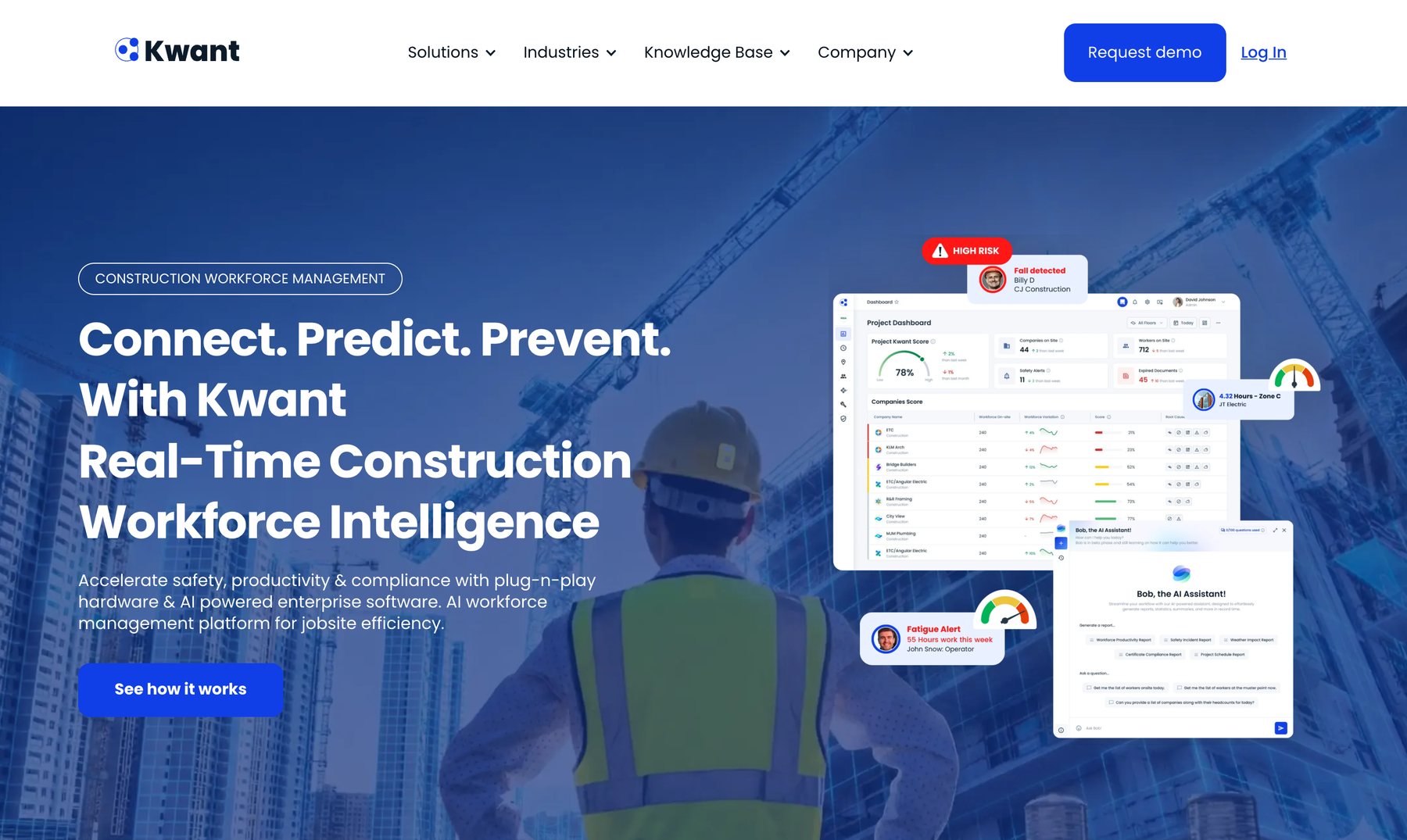
Kwant approaches the same site from the sensor side. Its smart wearables support worker location, restricted-zone alerts, fall detection and SOS functions, alongside onboarding and access control. The company says it supports four of the largest U.S. data center builders.
The structural point is that the same event can matter to both safety and security teams. A worker entering a restricted electrical zone may need immediate help or may lack authorization to be there. Connecting location with training and access permissions gives the team more context for its response. A safety use case can give the product a clear starting point, but broader use of the data still requires worker trust and explicit rules about who can see it. Kwant describes role-based access and options to limit the display of individual identities; how the contractor configures and uses those controls matters.
The opportunity sits among established systems as well as newer entrants, which makes integration and ownership of the customer workflow important competitive questions.
Why this goes beyond construction tech into financial services and insurance
The financial connection begins with the record. An owner, insurer or claims team may need to establish who had access, which work was authorized, what happened and how the contractor responded. A security system that preserves that evidence can become useful beyond the immediate incident.
That does not make a well-documented site automatically insurable on better terms. Builders risk, liability, delay coverage and surety address different exposures and depend on different evidence. A carrier needs to know whether the data is complete, whether the controls were actually used and whether they help explain loss experience. A badge log alone does not establish the condition of a project or the scope of coverage.
There is already precedent for construction technology influencing underwriting. Shepherd describes using technology-adoption data in its underwriting and offering qualifying customers insurance benefits. The opportunity is to make site evidence more useful and specific, including whether access and safety controls were maintained as the project changed.
The schedule is what makes this consequential for data centers. If a theft or incident interrupts critical-path work, the owner may face replacement lead times, idle crews, additional financing costs or a later revenue start. The amount depends on the component, available substitutes, schedule float and commercial commitments. A $100,000 theft can become a much larger delivery problem, but that needs to be demonstrated for the project rather than assumed from the value of the missing material.
For a technology company, an insurance relationship could create another route to customers if the carrier sees enough value to encourage adoption. That requires evidence of better risk assessment or outcomes, and a workable way to share the data. It is a plausible extension of the security business, with a separate commercial case to prove.
What we look for
When we evaluate companies here, four questions do most of the work.
Does it produce a record someone else will pay for? A record that supports an audit, a claim or an underwriting decision can have value beyond the security budget. The company needs to identify that user, the decision they make and the evidence they require. Data collection alone does not create a second buyer.
Does it survive the tier problem? A platform that works when the general contractor adopts it, but breaks at the third and fourth subcontractor tiers, has not solved the identity layer. The hard part is getting a two-person agency crew onboarded on a Monday morning without a laptop, then keeping its status current when the assignment changes.
Is it deployable before permanent power? Site protection may be needed before a permanent network or building is available. Cellular connectivity, battery or solar power and the ability to keep working through an outage matter. So do installation time and the effort required to move equipment as the job progresses.
Does the data survive turnover? A useful construction record should remain accessible after the project team demobilizes. Handoff to the owner can support incident review, insurance claims or ongoing operations. A longer customer relationship depends on whether the next team has a use for the record and can obtain it in a usable form.
What technology does not fix
Worth being direct about the limits. Access control does not create electricians. Verifying that a credential exists does not, by itself, establish that it was legitimately issued or that the person presenting it is its owner. Airspace response depends on legal authority and operational coordination as well as technology. And a system that detects an exception only helps if someone has responsibility for resolving it.
There is also a real tension in worker tracking. A badge that reports location can support a rescue, enforce access rules or monitor an individual’s movements. Workers need to understand what is collected and why. Access permissions, retention limits, appropriate consent and a way to correct inaccurate records belong in the deployment plan. A system introduced for safety can lose trust if the information is quietly repurposed.
The record is the asset
At MetaProp, we keep returning to the value of data that connects a physical event to a contractual obligation. On a construction site, that means knowing who was present, which contractor they worked for, what they were cleared to do and what evidence supports the answer.
The access log is part of that record, alongside credentials, incident reports, insurance documents and the actions taken when something went wrong. The investment opportunity is in making those pieces usable together, so that site teams can act and owners can understand the risk they are carrying through construction.
A data center’s security requirements begin well before commissioning. Protecting the build means keeping up with the movement of people, equipment and responsibility throughout the project. The companies that do that reliably can earn a place in both the construction workflow and the decisions that finance and insure it.
If you are building in this area, we would like to hear from you.
Disclosure: Odin, Kwant, Jones, Actuate and Billy are MetaProp portfolio companies. Nothing here is investment advice or a recommendation of any security.